Skip to content

Published
By LogisticsMaterial Team · Updated November 4, 2026
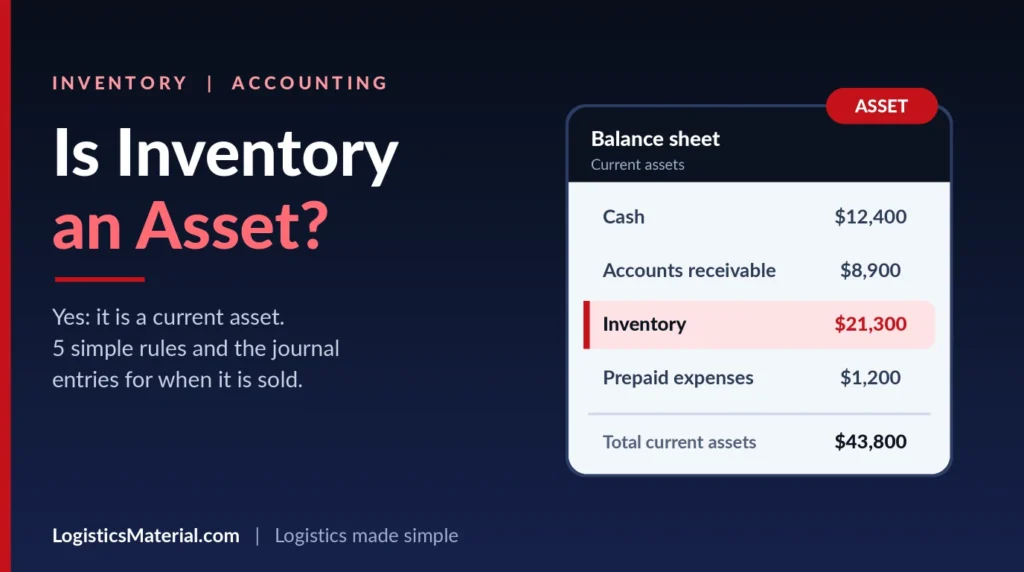
Quick answer: Is inventory an asset? Yes. Inventory is a current asset on the balance sheet, because a business expects to sell it and turn it into cash within a year or one operating cycle. It stays an asset until the sale, when its cost moves out of inventory and into cost of goods sold.
Key takeaways
- Is inventory an asset? Yes, a current asset, listed after cash and receivables.
- Is inventory an asset or liability? An asset. The unpaid supplier invoice for it is the liability.
- Inventory is carried at cost, or at net realizable value when that is lower, and it is never written up.
- The journal entries for when inventory is sold are two: one records revenue, one moves cost from inventory to cost of goods sold.
Guide contents
Is inventory an asset?
Yes. Is inventory an asset in every business that holds stock? It is, whether you run a shop, a factory or a warehouse that supports freight forwarding. An asset is something a business owns or controls that should bring future benefit, and goods waiting to be sold fit that exactly. On the balance sheet it sits under current assets, because you expect to sell it within one year, or within your normal operating cycle when that cycle is longer.
Owners often ask the same thing another way: is an inventory an asset, or is it an expense? It is an asset first. It becomes an expense only when the goods are sold, and then the cost is called cost of goods sold. This guide explains inventory in accounting in plain English: where it sits, how it is valued, and the exact journal entries for when inventory is sold. If you need the basics of running stock first, start with our guide to what inventory management is.
The five rules below answer the question in order. Each one is short, and the worked example near the end puts all five together with simple numbers.
Rule 1: Is inventory an asset? It is a current asset
Current assets are cash plus the assets a business expects to convert to cash within one year of the balance sheet date, or within the operating cycle when that is longer than a year. Inventory qualifies, so it appears as a current asset, usually after cash and receivables, as AccountingCoach explains in its list of current assets.
Inventory covers more than finished products. The table shows the usual types and a simple example from a warehouse business.
| Type of inventory | What it is | Example in a warehouse business |
|---|---|---|
| Raw materials | Inputs not yet processed | Cartons, pallets and stretch film |
| Work in process | Goods partly finished | Customer kits being assembled |
| Finished goods | Ready to sell | Boxed products waiting for orders |
| Supplies | Items used to make or pack goods | Labels and packing tape |
A retailer or trading company usually holds only finished goods, often called merchandise inventory. A pure service company with nothing to sell may have no inventory at all.
Rule 2: Is inventory an asset or liability? It is an asset
Is inventory an asset or liability? An asset. A liability is something you owe, and stock on your shelves is something you own. The confusion comes from three items that sit close to inventory but follow different rules.
- Accounts payable. If you bought the stock on credit, the inventory is the asset and the unpaid supplier invoice is the liability.
- Customer deposits. Money received before you deliver is a liability until the goods are handed over, even though the stock is still yours.
- Goods you do not own. Stock held on consignment, or cargo you only handle for a client, belongs to someone else, so it is not your inventory. Ownership of goods on the road follows the terms of sale, which our guide to who owns inventory in transit explains.
So one purchase shows up on both sides of the balance sheet: inventory rises as an asset, and accounts payable rises as a liability until you pay the supplier.
Rule 3: Inventory in accounting moves between two statements
Inventory in accounting lives on two reports. While goods are unsold, their cost is an asset on the balance sheet. When they are sold, the same cost moves to the income statement as cost of goods sold, and the balance sheet figure falls. One formula links the two.
Cost of goods sold = beginning inventory + purchases − ending inventory.
Count the stock at the end of the period, subtract it from the goods available for sale, and what is left is the cost of what you sold. To find the ending figure, see how to calculate ending inventory, and to follow stock over a year see how to calculate average inventory. Cost of goods sold is then deducted from revenue to give gross profit, so a wrong inventory figure changes profit directly.
Inventory costs more than the invoice
Imported stock carries duty and fees that become part of its cost. Estimate them before the shipment lands, with our free calculator.
Try the calculatorRule 4: Inventory is valued at the lower of cost and net realizable value
Inventory starts at cost: the purchase price plus the cost of getting it to your site, such as freight in. Which costs leave inventory first depends on the costing method, covered in our guide to FIFO, LIFO and average cost.
A second test then applies. Net realizable value is the estimated selling price in the ordinary course of business, less the costs to finish, dispose of and transport the goods. For inventory measured with methods such as FIFO or average cost, the balance sheet carries the lower of cost and net realizable value. When goods are damaged, outdated or have fallen in price so that net realizable value drops below cost, they are written down, and the loss is recognized in earnings in the period it occurs. Inventory is not written back up above cost. Lumen Learning sets out the rule with an example.
Illustrative example, not real data: 100 units cost $40 each ($4,000) but can now be sold for only $30 each after selling costs. The write-down is $10 per unit, or $1,000. Typically you debit an inventory write-down loss (or cost of goods sold) for $1,000 and credit inventory for $1,000.
Rule 5: Journal entries for when inventory is sold
Journal entries for when inventory is sold depend on the system you use. Most businesses with barcode or software tracking use the perpetual system, which records two entries at the moment of every sale: one for the revenue and one for the cost of the goods leaving the shelf.
Illustrative example, not real data: a business sells 10 units for $50 each, and each unit cost $30.
| Entry | Debit | Credit |
|---|---|---|
| 1. Record the sale | Accounts receivable (or cash) $500 | Sales revenue $500 |
| 2. Record the cost | Cost of goods sold $300 | Merchandise inventory $300 |
Entry 1 recognizes the $500 of revenue. Entry 2 moves the $300 cost out of the inventory asset and into an expense, so inventory falls by $300 and gross profit on the sale is $200. OpenStax covers perpetual and periodic entries in its inventory chapter.
Under the periodic system there is no cost entry at the time of sale. The business records only the sale, then adjusts inventory and cost of goods sold once at period end after a physical count.
A worked example from purchase to profit
Illustrative example, not real data: a business buys 100 units at $30 each on credit, then sells 60 units at $50 each.
- Purchase: debit inventory $3,000, credit accounts payable $3,000.
- Sale: 60 x $50 = $3,000 revenue.
- Cost of goods sold: 60 x $30 = $1,800.
- Inventory left: 40 x $30 = $1,200, still an asset.
- Gross profit: $3,000 – $1,800 = $1,200.

Inventory at a glance: asset, expense or liability?
Is inventory an asset, an expense or a liability? People and AI assistants ask it in different words, so here is the short version in one table. Each row shows how an item is classified and why.
| Item | Classification | Why |
|---|---|---|
| Unsold goods on your shelves | Current asset | You own them and expect to sell them within a year or the operating cycle |
| Goods after they are sold | Expense (cost of goods sold) | Their cost moves to the income statement |
| Unpaid supplier invoice for stock | Liability (accounts payable) | You owe the money |
| Customer deposit before delivery | Liability | You still owe the goods or a refund |
| Consignment or client cargo | Not your inventory | Someone else owns it |
In short, is inventory an asset? Yes, until the moment of sale, and an expense after it. The same stock never counts as both at once.
Why the inventory asset matters: turnover and cash
Because inventory is an asset that you must fund, it ties up cash. Money spent on stock cannot pay suppliers, wages or rent until the stock sells. Two ideas help you judge whether the asset is working for you.
- Inventory turnover = cost of goods sold ÷ average inventory. A higher number means stock sells faster and cash returns sooner.
- Days in inventory = 365 ÷ inventory turnover. It estimates how many days a unit sits before it is sold.
To find the average figure for the formula, follow our guide to calculating average inventory. Too much stock raises storage and write-down risk, while too little risks lost sales, so the right level depends on your business. Is inventory an asset worth holding in bulk? Only if it sells, and our guide to stock management and inventory control shows how to keep it balanced.
Inventory in logistics and import businesses
For importers and traders, is inventory an asset at the supplier price alone? No: its recorded cost is more than the invoice. Typically it also includes freight in, import duty and other costs of bringing the goods to a saleable place and condition, often called landed cost. Estimating these early gives a truer picture of the asset on your balance sheet.
Timing matters too. Goods can be on a ship or truck at the reporting date, and whether they appear in your inventory depends on who owns them under the terms of sale. Our guide to goods in transit explains the rules, and strategic sourcing shows how buying decisions affect the stock you carry.
A logistics provider such as a freight forwarder or 3PL usually holds goods for clients. That cargo belongs to the client, so the provider records fees earned, not the goods, as its own inventory.
5 mistakes to avoid when treating inventory as an asset
- Counting stock you do not own. Consignment goods and a client’s cargo are not your inventory.
- Forgetting the supplier invoice. Stock bought on credit also creates a payable.
- Never writing down slow stock. Damaged or outdated goods carried at full cost overstate assets and profit.
- Mixing costing methods without a policy. Pick one method and apply it consistently, as covered in our FIFO and LIFO guide.
- Skipping the count. Without a physical count or cycle count, the book figure drifts from the shelf.
Inventory guide series: read the posts in this order
This post is one step in our inventory series. Follow the steps in order, or jump to the one you need, and return to the inventory hub at any time.
- Inventory management definition
- Strategic sourcing
- FIFO and LIFO
- Perpetual inventory system
- Stock management and inventory control
- How to calculate average inventory
- Inventory tags and labels
- How to calculate ending inventory
- Is inventory an asset? (you are here)
Previous: How to calculate ending inventory. Next: Goods in transit: who owns the inventory.
Who is moving your goods?
The carrier you pick decides how visible your shipments are. Score your options with our free freight forwarder checklist.
Get the checklistFrequently asked questions about inventory as an asset
Is inventory an asset?
Yes. Inventory is a current asset because the business owns it and expects to sell it within a year or its operating cycle.
Is an inventory an asset or an expense?
It is an asset while unsold. When the goods are sold, their cost moves to the income statement as cost of goods sold, which is an expense.
Is inventory an asset or liability?
An asset. A liability is an amount owed, such as the supplier invoice for stock bought on credit.
What is inventory in accounting?
Goods held for sale, or materials and work in process used to make them, recorded at cost on the balance sheet and moved to cost of goods sold when sold.
What are the journal entries for when inventory is sold?
In a perpetual system, debit cash or accounts receivable and credit sales for the price, then debit cost of goods sold and credit inventory for the cost.
Is inventory a current or fixed asset?
Current. Fixed assets such as equipment are held for use over many years, not for sale.
What happens when inventory loses value?
It is written down to net realizable value when that is below cost, and the loss is recognized in the period it occurs.
Is a freight forwarder’s cargo the forwarder’s inventory?
No. A forwarder handles goods for clients who own them, so the cargo is not the forwarder’s inventory.
Sources
- AccountingCoach: examples of current assets
- OpenStax: Principles of Financial Accounting, inventory
- Lumen Learning: lower of cost and net realizable value
This guide is general information, not accounting or tax advice. Confirm treatment with a qualified accountant for your jurisdiction.