Skip to content

Published Updated
By LogisticsMaterial Team · Updated November 2, 2026
Quick answer: Goods in transit are included in a purchaser’s inventory when the buyer owns them, which is usually under FOB shipping point terms. Under FOB destination terms the seller keeps them in its inventory until delivery. Check the sales terms, the shipping date and the year-end cut-off, then record the goods once, on one side only.
Guide contents
What are goods in transit?
Goods in transit are products a seller has already shipped but the buyer has not yet received. They are on a truck, a vessel, a plane or parked in a carrier’s yard. Nobody’s shelf holds them, yet somebody’s balance sheet should. Warehouse teams call them “the stuff still on the road”. Accountants prefer a more formal term, and they hold stronger opinions about it.
The question that causes the trouble is a simple one: who owns the goods while they travel? Answer it wrongly at year-end and one company counts the same pallet twice while the other counts it zero times. Nobody lied. Two teams just used different rules.
This guide answers the question the way people actually search it: are goods in transit included in a purchaser’s inventory, and when? You will get 5 easy rules, a comparison table, a worked year-end example and a cut-off checklist. It sits right next to our guide to how to calculate ending inventory, because every mistake in this area eventually lands in that number.
5 easy rules to decide who owns goods in transit
Work through these in order. Most real cases are settled by the first rule, and the others cover the awkward leftovers.
Rule 1: Read the shipping term first
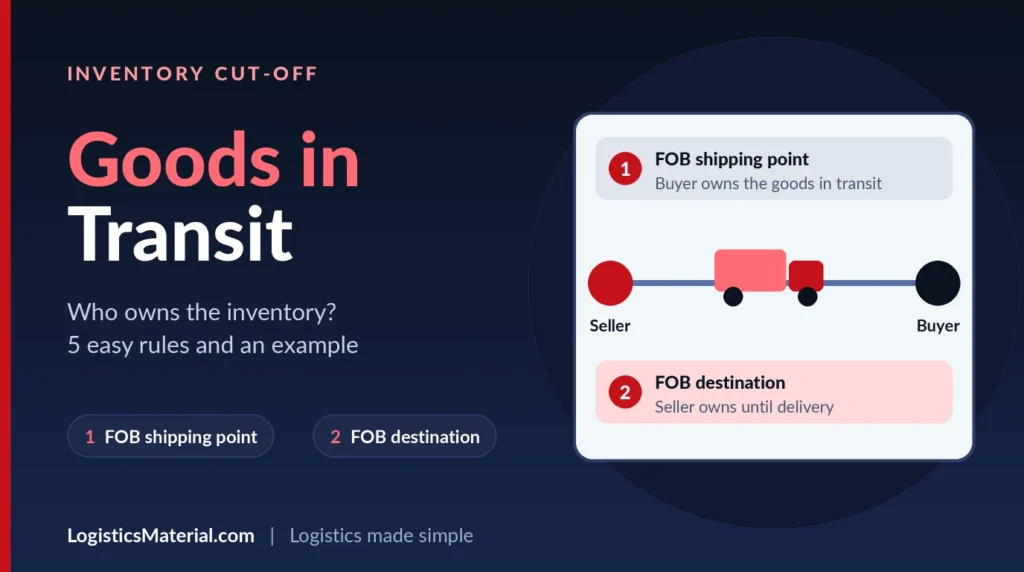
The shipping term in the sales contract decides ownership in most accounting cases. Under FOB shipping point, the buyer owns the goods in transit as soon as they leave the seller’s location, so the buyer includes them in its inventory. Under FOB destination, the seller keeps ownership until the goods arrive, so they stay in the seller’s inventory while they travel.
Rule 2: Do not assume risk and title always move together
The ICC describes Incoterms rules as defining the tasks, costs and risks of delivering goods from seller to buyer. Whether legal title moves at the same moment is a question for the sales contract and the governing law. So for a year-end count, ask what the contract says about title, not just which three letters sit on the invoice.
If the paperwork is silent, ask your accountant before you count anything. Agree the terms while you negotiate with suppliers, as described in our strategic sourcing process, so the question never reaches year-end unanswered.
Rule 3: A named place sets the point
A term such as “FOB Denver” names the spot where ownership changes hands. The carrier at that named place is treated as the buyer’s agent, which means the seller keeps title and risk until the goods reach that point. The place on the paperwork matters as much as the letters.
Rule 4: The owner records the inventory, and the freight follows
Whoever owns the goods counts them. Freight follows the same logic. Under shipping point terms the buyer pays freight-in, and that cost is added to the inventory, then moves into cost of goods sold when the stock is sold. Under destination terms the seller pays the freight and records it as a delivery expense, which is a selling expense.
Rule 5: Consigned goods never belong to the holder
Consigned inventory stays on the books of the supplier, called the consignor, until the holder sells it to a customer. The holder, called the consignee, should leave consigned stock out of its own count even though it sits in its own warehouse. We cover the details in the consigned inventory section below.
FOB shipping point vs FOB destination at a glance
Here is the comparison most readers want. Keep it open while you work through your shipments.
| Question | FOB shipping point | FOB destination |
|---|---|---|
| Who owns goods in transit? | Buyer | Seller |
| Who includes them in inventory? | Buyer | Seller |
| When does ownership change? | When the goods leave the seller | When the goods arrive at the buyer |
| Who pays the freight? | Buyer, as freight-in | Seller, as delivery expense |
| Who bears the risk of loss in transit? | Buyer | Seller |

Print it, pin it above your desk, or tape it to the monitor of whoever runs the year-end cut-off. One glance at the shipping term settles most of the arguments before they start.
Worked example: a December 29 shipment at year-end
Here is a simple, illustrative case with round numbers. A small distributor has a December 31 year-end. On December 29 a supplier ships 500 units at $20 each, plus $600 of freight. The goods arrive on January 3. The shelf count on December 31 shows $42,000 of stock.
| Item | FOB shipping point | FOB destination |
|---|---|---|
| Shelf count on December 31 | $42,000 | $42,000 |
| Goods in transit (500 units at $20) | $10,000 | $0 |
| Freight on the shipment | $600 | $0 |
| Buyer’s ending inventory | $52,600 | $42,000 |
| What the seller does | Records the sale on December 29 and leaves the goods out of its count | Keeps the goods in its December 31 inventory until January 3 |
Under shipping point terms the buyer adds $10,600 to its ending inventory: the units plus the freight it pays. Under destination terms the buyer adds nothing, and the seller counts the cost of those 500 units in its own stock. Same truck, same road, two different balance sheets.
Now see why the cut-off matters. Suppose the buyer already booked the $10,600 invoice as a purchase but left the goods out of its count. Cost of goods sold equals beginning inventory plus purchases minus ending inventory, so cost of goods sold is overstated by $10,600 and gross profit is understated by the same amount. Nothing moved in the warehouse, yet the profit changed. Our ending inventory guide shows that formula step by step.
Notice that nobody in this example did anything strange. Both companies followed a consistent cut-off. The trouble starts when one side treats a shipment as shipping point and the other treats it as destination.
Ex works vs FOB: where Incoterms fit in
Accounting classes talk about FOB shipping point and FOB destination. International contracts use Incoterms rules instead, and the two vocabularies overlap without being identical.
The ICC explains that under Incoterms 2020 delivery and the transfer of risk are linked in all 11 rules, and the delivery point differs by rule: EXW at the seller’s named premises, the F-group at a carrier or vessel point, the C-group at a shipment point even though the seller pays for carriage, and the D-group at the named destination.
Duty changes and currency moves can also change what that stock is worth on arrival, as the global trade drivers guide shows.
| Incoterms rule | Where delivery and risk pass | Usual reading (confirm with your accountant) |
|---|---|---|
| EXW (ex works) | At the seller’s named premises | Like shipping point: the buyer carries the goods for the whole journey |
| FOB (free on board) | At the named port of shipment, once the goods are on board | Like shipping point: the buyer carries the goods once they are loaded |
| CIF or CIP | At the shipment point, even though the seller pays for carriage | Risk has already passed to the buyer, so treat it like shipping point for risk |
| DAP or DDP | At the named destination | Like destination: the seller carries the goods until they arrive |
The ex works vs FOB difference is mostly about where the seller’s job ends. With ex works the buyer takes over at the seller’s door. With FOB the seller gets the goods on board the vessel at the named port and the buyer takes over from there.
Incoterms FOB is designed for sea and inland waterway transport, so a container moved by truck or rail is usually better served by FCA. If a forwarder handles the move, ask for the date the goods were handed over, and use our guide to finding and choosing a freight forwarder to compare options.
Longer routes make this more than theory. When a voyage is rerouted and takes extra days, more shipments cross the year-end line, as we explain in our guide to the Red Sea shipping crisis.
Duty rides along with the goods
Goods in transit often carry import duty and fees you will owe on arrival. Estimate them before the shipment lands, with our free calculator.
Try the calculatorConsigned inventory: who owns stock that someone else holds?
Consigned inventory is the mirror image of goods in transit. The stock sits in the consignee’s warehouse or shop, yet the consignor still owns it until the consignee sells it to a customer. So consigned inventory stays on the consignor’s books and stays out of the consignee’s inventory count.
The practical fix is boring and effective. Give consigned items their own location or status in your system so the year-end count never mixes them with your own stock. The month-end checklist in our ending inventory guide already tells you to remove consignment stock, and this is how you make that step easy.
A year-end cut-off checklist for inventory in transit
- Pull every purchase order, supplier invoice and bill of lading dated in the last two weeks of the period.
- Write the shipping term and the ship date next to each one.
- Mark every shipment that left before the cut-off and arrived after it.
- Add the goods in transit you own, at invoice cost plus the freight you pay.
- Remove the goods the seller still owns, and any consigned stock.
- Check the result against the receiving records for the first week of the next period.
- Keep a one-page schedule so an auditor can follow every line without calling you at home.
Ten minutes per shipment beats ten hours of explaining to an auditor, and it makes your physical inventory count far calmer.
How to keep inventory in transit visible all year
Year-end is only where the mistakes show up. The cause is usually quieter: nobody owns the gap between shipped and received.
- Give transit its own status. Mark stock as in transit from the ship date, with an expected arrival date next to it.
- Keep the paperwork together. Store the purchase order, the invoice, the bill of lading and the carrier tracking number in one place.
- Reconcile weekly. Compare open shipments with carrier tracking and with what receiving has logged.
- Ask your 3PL for status reports. If a provider stores or moves stock for you, request in-transit and received reports, as described in our 3PL logistics guide.
- Insure the risk you carry. The party that bears the risk of loss in transit should check that the cargo is insured for that stretch.
A perpetual inventory system makes this easier, because every receipt posts as it happens and the in-transit list shrinks on its own.
For several sites and stock on the water, cloud inventory tracking shows owned and available units side by side, as in its worked example.
5 common mistakes with inventory in transit
- Counting the same shipment twice. It appears on the shipped list, then again on the shelf after it arrives.
- Using the invoice date instead of the ship date. Ownership follows the shipping term and the movement of the goods, so check the bill of lading, not just the invoice. Our bill of lading guide for forwarders shows what each copy proves.
- Forgetting the freight. Under shipping point terms the freight the buyer pays is part of the inventory cost.
- Mixing vocabularies. A contract that says FOB may mean the accounting term or the Incoterms rule, and the two do not always line up. Read the full clause.
- Ignoring returns on the road. Goods that customers send back and that are still moving need the same check, because the contract decides who owns them while they travel.
Who is moving your goods?
The carrier you pick decides how visible your shipments are. Score your options with our free freight forwarder checklist.
Get the checklistHow this connects to your other inventory numbers
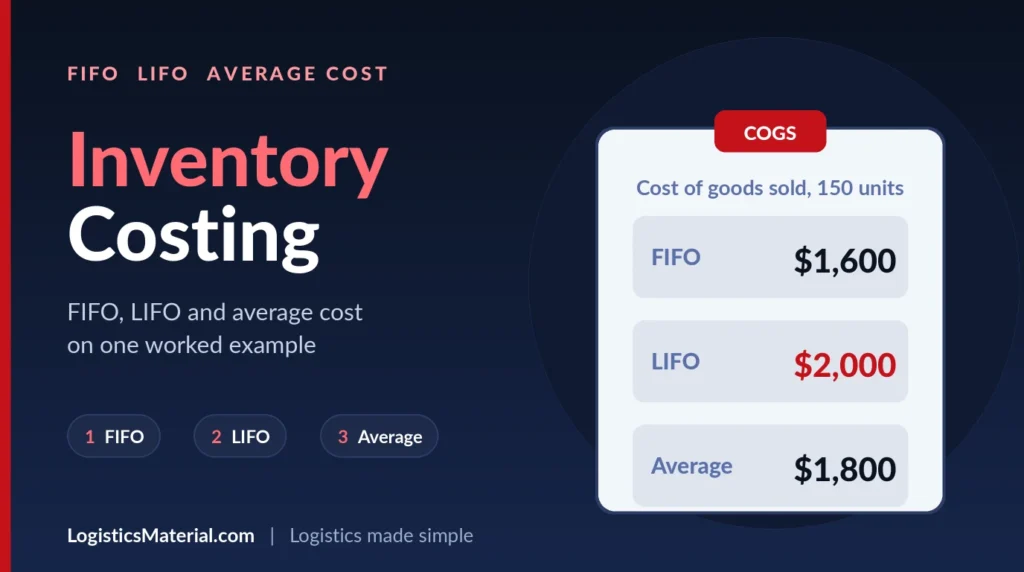
Goods in transit feed straight into ending inventory, which sets your cost of goods sold. That same ending figure is half of the calculation in our guide to how to calculate average inventory, so one cut-off mistake quietly shifts your turnover numbers too. The cost you attach to each unit follows your cost flow method, which we compare in FIFO and LIFO.
If you are building the basics from scratch, start with what inventory management is and then browse the full inventory management hub.
Trusted sources on shipping terms and ownership
- AccountingCoach: What are goods in transit for the definition and a year-end timeline
- AccountingTools: When inventory ownership occurs under FOB terms for ownership, risk and named-place terms
- ICC Academy: Place of delivery and risk transfer for how Incoterms 2020 link delivery and risk
- Penn State open textbook: Shipping terms for freight-in and delivery expense examples
This guide is general education, not accounting, tax or legal advice. Ownership rules depend on your contract and your local law, so check them with a qualified accountant before you file.
Frequently asked questions
Are goods in transit included in a purchaser’s inventory?
Yes, when the buyer owns them. Under FOB shipping point terms the buyer includes goods in transit in its inventory from the moment they leave the seller. Under FOB destination terms the buyer waits until the goods arrive.
Who owns the goods while they are in transit?
The party named by the shipping term in the sales contract. Shipping point means the buyer owns them, and destination means the seller owns them. If the terms are unclear, confirm who holds title in the contract.
Are goods in transit included in ending inventory?
Only for the owner. Add them to your ending inventory if you own them at the cut-off, and leave them out if the seller still owns them.
What is the difference between FOB shipping point and FOB destination?
Under shipping point, ownership and risk pass to the buyer when the goods leave the seller, and the buyer pays the freight. Under destination, the seller keeps ownership and risk until the goods arrive and pays the freight.
Is inventory in transit a current asset?
When you own it, yes. Inventory in transit is part of inventory, which is a current asset because it is expected to be sold within a year or one operating cycle.
Who pays for goods lost in transit?
The party that bears the risk of loss, which follows the shipping term. That is the buyer under shipping point and the seller under destination. Insurance and carrier claims then decide who recovers the cost.
What does ex works vs FOB mean?
Under ex works the buyer takes over at the seller’s premises. Under FOB the seller puts the goods on board the vessel at the named port and the buyer takes over from there. Incoterms FOB is meant for sea and inland waterway transport.
What is consigned inventory?
Stock that one party holds but another party owns until it is sold. It stays on the consignor’s books and out of the consignee’s inventory count.
How do you record inventory in transit?
Record the purchase, the payable and the inventory on the date ownership passes to you. Many teams use a separate inventory in transit account so the goods stay visible until they arrive.